A chapter from the book by David Kier, Baja California Land of Missions …
Missions that Never Were and Lost Missions
One thing Baja California literature is not lacking in is the number of missions referred to that never were missions or were mythical, secret, or “lost missions.”
Travel in Baja California before the mid-1970s involved hundreds of miles of unpaved and often challenging roads. The adventure of the trip itself inspired many to write books about their excursion. Even before automobiles, when mules and burros were the means of travel, the peninsula inspired writers to share the adventure in print. Some of the more notable “mission” stories are documented below, whether the stories are disproved or not, the imagination and searching will no doubt continue.
Santa María Magdalena
One of Baja California’s first adventure books was Arthur North’s Camp and Camino in Lower California. North traveled the peninsula in 1905 and 1906 and his book was published in 1910. The missions and El Camino Real (The Royal Road or King’s Highway) were the focus of his expedition. North’s historical details were not always accurate, and many writers in the following years repeated his errors in their own books.
One of Arthur North’s errors was presuming that the La Magdalena ruins, seventeen miles northwest of Mulegé, were the proposed Jesuit mission of Santa María Magdalena. The Santa María Magdalena mission project was planned for the region far north of San Ignacio, as shown on the 1757 Jesuit map.
Books and maps published after North’s would continue to call the Magdalena site near Mulegé “Mission Santa María Magdalena.” No documentation supports this site as ever having been that or any other mission.
In 1966, mystery novel author Erle Stanley Gardner and his associates in off-road vehicles discovered some strange walls, thirty-five miles south of Bahía de los Ángeles that baffled explanation. On that expedition was Desert Magazine editor Choral Pepper, who later researched Jesuit writings and maps and concluded that the Gardner expedition had indeed found the “true” Santa María Magdalena site, 140 miles from North’s Magdalena. Perhaps this was an abandoned mission project after all? One of the bells hanging at the nearest mission to the south (Santa Gertrudis) reads “Santa María Magdalena 1739.” Was the bell intended for the mission that never was?
The mission of San Luis Gonzaga had a visita also named Santa María Magdalena (on the large bay of the same name). It was planned to be developed into a mission according to the Report of 1744. There is no other connection between the two sites.
To continue progress in California and obtain funding, the Jesuits listed their missions in a 1745 report. In that report are three northern, unfinished missions, which are also shown as “started” on their 1757 map. Santa María Magdalena, Dolores del Norte, and San Juan Bautista are these three missions.
1966 Desert Magazine  |
2009 David Kier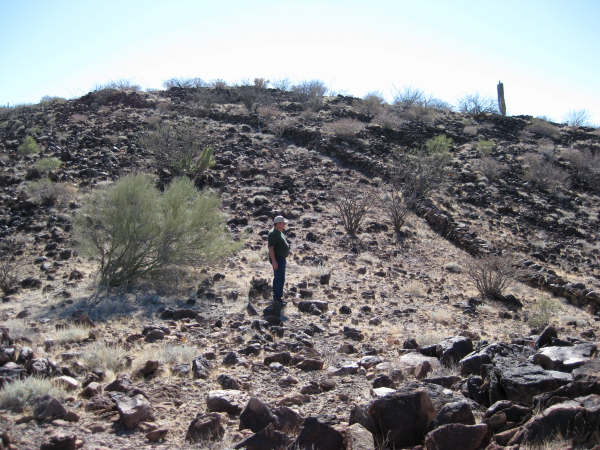 |
This mysterious wall was found by Choral Pepper and others exploring uncharted regions in central Baja California. Her research later concluded this was the unfinished mission project shown on the 1757 Jesuit map and named Santa María Magdalena. The location was forgotten by those on that expedition thirty-five years later when interviewed by the author. Finding this “lost mission” was a quest of the author and a great personal reward after several years searching for it. Additional photos: https://vivabaja.com/109
Dolores del Norte
Another Erle Stanley Gardner “lost mission” presumed to have been discovered was Dolores del Norte. Using helicopters to explore and locate rock art sites north of San Ignacio, back in the early 1960s, Gardner and friends came upon the small village of San Francisco de la Sierra. It was so remote that it had no automobile road and the expedition members brought in by helicopter were the first “outsiders” anyone in the village had ever seen. When Desert Magazine editor Choral Pepper asked villagers the significance of the old stone walls, they answered “Dolores.” While the mountain people may have really believed the walls were part of a mission named Dolores, the Jesuits’ documents do shed the light of truth on this mystery. Dolores del Norte was to be the next mission north of San Ignacio. When funding and a new missionary was finally available to open the mission, the name was changed to Santa Gertrudis, to honor the wife of its benefactor.
The adobe mission visita ruins in San Pablo Canyon, between San Ignacio and Santa Gertrudis, have also been called “Mission Dolores del Norte” by INAH. Some maps also show a mission of that name in the desert south of El Arco. In reality, the name Dolores del Norte existed only on paper and the mission of Santa Gertrudis is what became of it.
San Juan Bautista (Santa Clara)
The third mission the Jesuits listed on their 1745 report and the 1757 map as ‘started,’ was named San Juan Bautista. The 1757 map has it located west of San Ignacio in the Sierra Santa Clara, north of Punta Abreojos. While there is at least one reliable water spring in these desert hills, no ruins have ever been documented to exist. The Lost Santa Clara Mission legend is well-known to locals.
When the Jesuits were expelled from the New World by order of King Carlos III, some believe they had advance warning and collected all their valuable church possessions and treasures to hide in a secret mission. Santa Clara is considered by many as the best choice for this mission.

Santa Isabel
The most well-known Baja California lost mission legend is that of Santa Isabel. Unlike San Juan Bautista, not one word is mentioned of a Mission Santa Isabel on maps or documents from the Jesuits. Only a single water source along the gulf coast by that name is shown on their map. It is located between San Felipe and Bahía San Luis Gonzaga. This has led many lost mission hunters to explore the desert hills north of the last known Jesuit mission of Santa María.
The Santa Isabel legend developed out of suspicions about the Jesuits activities in California. They controlled the peninsula as an independent theocracy with full control of who came and left. Stories of accumulated treasures secreted away by the padres in one last, hidden mission were born and make entertaining reading. The truth is that the missions were always on the edge of economic failure. If not for the supplies from the mainland and generous benefactors in Europe, the missions in Baja California would have never survived.
Perhaps searching for lost missions in Baja California is more of an excuse or a reason to do some desert exploring. This author has enjoyed hiking with others seeking “lost missions,” knowing full well no treasures ever existed. The missionaries suffered great poverty, and the challenges to stay alive occupied most of their efforts, leaving no time available to collect treasures!
Others
Often books or maps have shown visitas as being missions or sometimes a mission’s second location as being a unique mission. Some sites that were never missions but shown as missions on maps include San Juan Londó, San Miguel (de Comondú), La Presentación, and El Novillo.
Calamajué is often shown or listed as either a mission or a visita. The documents clearly show that Calamajué was the first location for the seventeenth Jesuit mission. In less than a year, that mission was moved and renamed “Santa María.”
Near the modern town of Los Barriles (south of La Paz) a 1721 mission of Ensenada de las Palmas is sometimes shown or mentioned. This was simply an early proposed location for what would become Mission Santiago, established further inland. The first Santiago mission was begun in 1722 and known as Santiago de los Coras. However, that project was abandoned the following year when the church wall collapsed and killed many of the Cora Indians. In 1724, the mission was again started, but further south in the land of the Pericú Indians.
The Jesuits had made two earlier attempts to gain a foothold in California before the founding of the Mother Mission at Loreto. The first was in 1683 at La Paz and was called Guadalupe. The second was begun a few months later at San Bruno, fifteen miles north of Loreto. This colony was abandoned in 1685. These two colony attempts did provide the Jesuit, Padre Kino, with insight of how to succeed in California and that led to the success of Loreto in 1697.
One visita of Loreto was named Nuestra Señora de los Dolores and listed as a mission by Padre Píccolo in his Informe (report) of 1702. This should not be confused with the 1721 founded mission of Dolores, seventy miles south from Loreto. The 1721 mission was often called “Dolores del Sur” by the Jesuits in order to prevent confusion with the older visita.
See photos of all the true missions: https://vivabaja.com/mission-albums/
See the Visitas (ruins of satellite mission visiting chapels)
Discover more peninsula travel locations at https://vivabaja.com/